Tuesday, September 29, 2009

The Installation of Bob Stanley, Sac Poet Laureate

Here is an event I am looking forward to, the installation of Bob Stanley as the new Sacramento Poet Laureate on Sunday October 4. I will be reading a poem or two with other poets that include the former Sac Poet Laureate,Julia Connor, to celebrate Bob's new role.


Monday, September 28, 2009

Results of the Artsinitiates/Lion Press Short Story Competition

The results of the 2009 Artsinitiates/Lion Press Short Story Competition have been announced and below are the top ten winners. The success of my short story, "Call Center", is motivating, and may lead to some thematic indulgence. I am happy to see the familiar names on the list...Memory Dete (long time), Tham, Mzana, Tinashe and others, congratulations.

1. Call Centre - Emmanuel Sigauke
2. The Visa - Thamsanqa Ncube
3. An Ordinary Saturday Morning - Mzana Mthimukulu
4. Enamoured Paramour by Eleanor Madziva
5. Care-worker - Memory Dete

6. Naked Truth - Tinashe Muchuri
7. Blood Rain - Richmore Tera
8. Life is like that - Getrude Thandazani Mlambo
9. A new Start - Morden Mapani
10. Full Circle - George Phillip

The stories were judged by Wonder Guchu, Tinashe Mushakavanhu, Memory Chirere, Chris Mlalazi and Joyce Jenje-Makwenda.

Friday, September 25, 2009

Shona Flash Fiction: Gungano paGwavachemai


Vanga vakoromoka kubva kumativi akasiyana--Nhenga, Chatikobo, Mariwowo naGudo--vose ndokuungana paGwavachemai Secondary. Matunhu epedyo ese ndokukwitimira kuchikoroko, kunoona vatendi ava vainzi vairura, zvikwapuro zvemadhimoni neimwe mweya yakasviba. Isu nhundurwa mbishi takasvika dandare rati pamu-pamu nevadzani, mikwimba yevarume nezvikadzi zvaivanga pasi. Ngoma ndokuchidandaurwa.

Kwakatambwa vehama, usiku hwose ngoma ichitsemurwa, pasi pachirikitwa. Mharidzo dzikaitwa nedzaitaudza matombo. Zvigagairwa zvikaimba kusvikira zvarasa mazwi, uku vatambi vachingokweshana, ngoma ikati mati manzwei.

Kuchinonzi vabaiwa neshoko tendeukai, tose dungwe rongondo. Pwere neharahwa dzeMototi ndokutendeuka. Tichibvawo tadzibatiswa ngoma, ndokuripinda dariro. Kwakadzaniwa, chikuruva mone sepairwa mabhuru mana.

Pakazoedza repiri zuva, tese tanga tadhamba, uku ngoma dzaibva nekurikitwa, dzati rabada....

James Kilgore: We are All Zimbabweans Now


I just got, from the author, information about this novel that is set in Zimbabwe. It's is entitled We Are All Zimbabweans Now, and from the reviews and blurbs, its premise seems interesting. The book was published by Umuzi (Cape Town), a division of Random House.

Here is some information about the novel and author:

Description

In 1981 a young American historian arrives in Zimbabwe, full of idealism and enthusiasm for the benevolent new Prime Minister Robert Mugabe and the post-colonial new beginning for that country. His historic research leads him to an apparent murder case, unresolved since the days of the bush war. As he draws – or is lead – or yet mislead – closer to an answer, he becomes involved with a local woman through whom he soon finds himself in the inner circle of the new ruling class. Once the euphoria starts dissipating he encounters increasingly menacing instances of corruption and repression, including threats to himself to abandon his investigation. With every new revelation a new layer of decay is exposed and with that, his idealism retreats. In the process, the meaning of the novel’s title, taken from Mugabe’s conciliatory rhetoric at the beginning, gradually comes to mean: we are all trapped and compromised into the moral tangle and the destruction into which all the promise has degenerated. James Kilgore’s debut is an extremely accomplished and compelling novel that deftly employs the instruments of a detective thriller.

About the author

James Kilgore first made news in South Africa when he was arrested in Cape Town in 2002. He had been living under the alias Dr John Pape and become a respected academic at the University of Cape Town. U.S. authorities extradited him to California where he served six and a half years in prison. He was released 10 May 2009. Kilgore grew up in California and lived in the volatile San Francisco Bay Area during the late 60s and early 70s. He became immersed in left-wing politics, eventually linking up with the Symbionese Liberation Army (SLA). His involvement with the SLA led to an indictment for possession of explosives in 1975. Kilgore then fled the law for 27 years, living in Zimbabwe, Australia and South Africa. He abandoned the politics violence, focusing on a career as an educator. He resided in Harare, the site of We are all Zimbabweans Now, from 1982–91. Here he met his wife, Terri and also wrote a doctoral dissertation on the history of domestic workers in Zimbabwe. From Harare James and Terri moved to South Africa where he worked as an educator and director for both Khanya College in Johannesburg and the International Labour Research and Information Group (ILRIG) in Cape Town. He earned a reputation as a champion of workers and the poor. He currently lives with Terri and their two sons, in Illinois, U.S.A. We are all Zimbabweans Now is his first novel and his first publication under his real name. He is currently working on manuscripts of seven other novels which he wrote during his incarceration.

I look forward to reading this new addition to the growing literature about Zimbabwe. As one of the reviewers said, I want to see a piece of myself in the novel, which covers a very important time in Zimbabwean history.

Tuesday, September 22, 2009

The Boy Next Door Trailer

Monday, September 21, 2009

Discussing Short Stories on Oprah.com

It's clear (at least to me)by now that I am very excited about the selection of Uwem Akpan's Say You're One of them to the Oprah Book Club. I had already bought the book three weeks earlier, which meant that I paid a higher price than the $8.00 or so it is going for now since its on a 30 percent discount in many bookstores. Yes, very many bookstores, nearly ALL bookstores, and retail and grocery stores. I have already seen many copies in places like Borders, Barnes and Noble, now it's everywhere: Target, Costco, Rite AID, and of course, all the online outlets. It's everywhere, because Oprah recommended it, but most importantly because Akpan wrote it the way he did, which led to an agent liking it enough to sell it to Little, Brown and Company where it fell in the hands of caring editors and publicity personnel... For them, as it is for Akpan, for African literature, and for the short story genre, it's a huge success. For that reason (the causal process here doesn't have to make great sense), I have joined the discussion group at Oprah.com, and I have started posting comments.

Here is how things work at oprah.com. Discussion questions about the selected book are posted, and there is a generous reading schedule. You can post comments under the discussion forum, or post an answer to the discussion question, or do both. I am going to do both, and I promise to read everyone's comment. This is like a study of how an African fictional work does in America (using the readers who read what Oprah recommends, and based on my experience with books and bookstore, that readership puts someone on the bestseller lists of America). So far, most are saying great things. There are those who feel the book is too painful, others are struggling with some aspects of "African English", but generally, they all seem engaged.

So here is an example of my participation in some of the discussions:

Question: In “An Ex-mas Feast,” Maisha leaves her family to become a full-time prostitute. Do you think she chose to depart, or did her family’s poverty force her to flee? Is it possible to have complete freedom of will in such a situation? Is it reasonable to judge a person for her actions if her choice is not entirely her own?

Answers: First, we need to realize that Maisha is only twelve and already a prostitute; the issue of choice should not even come into play. She is a kid who should be receiving the care of her parents, but is born in a situation that does not allow her to be a child. She didn’t choose to depart, but that was the only way she could liberate herself later in life and enable her brother to attend school. The parents also have their hopes anchored on her, now that she has attracted some white tourists.

These people are victims of something larger in Kenya, be it the politics of the country (which is hinted at), or the parents’ failure in life. Yet even in their desolate state, they have dreams and hopes, something which forces the reader to blame their condition on something beyond their control, just as we cannot blame Maisha for what she ends up doing. Choice is out of the question…she is twelve. It’s a shame that wealthy men come to these streets looking for the child prostitutes; and some of the “clients” are from places like the United States, Jaguar-driving men who promise hope but deliver life-long scars…

So this is what the members of the club get to do and it feels like fun. I am working on the second story since I am ahead of the reading schedule.

Friday, September 18, 2009

Uwem Akpan is now one of them...

"Now, let's hope that literary agents and editors will begin to consider our manuscripts seriously," writes Chielo Zona Eze, author of The Trial of Robert Mugabe, in his comment about the new Oprah Book Club selection, Say You Are One of them by Nigerian author and Jesuit ordained priest Uwem Akpan. Eze makes a great point here, since publishing is driven by these kinds of market forces, and it goes without saying that Oprah is a big force in the publishing industry.

I am happy that Akpan's stories (set in Africa) will gain greater exposure now...; and yes, quite a few important people in the American book world will notice more such works as this one. The book was published by Little, Brown & Company, a company that knows how to market its books. I bought my copy of Akpan's book three weeks ago at Barnes and Noble where it was on a special display with other African books.

I am currently reading another of Little, Brown's latest African publications, The Boy Next Door by Zimbabwean author Irene Sabatini. I don't see anything stopping this book from appealing to English readers of diverse backgrounds; it's one of the most accessible books that I have ever read, yet it still manages to portray the distinct details of what most American readers would see as a different culture.

It's a happy hour for African literature, and as Chielo says, it's time to give more African manuscripts a serious look....

Ruzvidzo Mupfudza Featured in Rattlesnake Review

I just picked up my copy of the Rattlesnake Review 23 at the Book Collector. I was waiting for this one since it carries my poem, but as I was looking for the poem (which is on page 49), I was pleased to see poems by Zimbabwean poets Tinashe Muchuri and Julius Chingono (on page 48), and right on the next page from where mine was, there was a two-page spread of Ruzvidzo Stanley Mupfudza's work!

I know Mupfudza very well, from our University of Zimbabwe days, and he is my friend on Facebook where we chat sometimes. It's amazing how things are connecting in this internet world, but I am most impressed by the growing poetic connection between Sacramento and Harare. They are fast becoming poetic sister cities.

In issue 22, Rattlesnake Review guest featured Tinashe Muchuri, another good friend of mine in the writing world. These two are well-connected writers in Zimbabwe, so it is likely that Rattlesnake may see an upsurge in submissions from Zimbabwe. And that's good, because Zim writers are speaking, now that the media is quieter on the "Zimbabwean situation". The emotions have tranquilized, and the art is emerging, and what we are reading is just a taste of a lot more to come. This I know for a fact...

Congratulations to the Zimbabwean poets appearing on the pages of this wonderful Northen California journal. Great job Kathy Kieth at Rattlesnake for reaching far and wide in your search for artistic talent.

Thursday, September 17, 2009

The Delicate Art of Writing About Real People

We all do it; we write about real people, whether we use just a few details about a person we know. Then there are those who will base whole characters on real people, but attempt to fictionalise everything. Both fiction and non-fiction are based on real life, and how close we are to the specific details that inspire our writing depends on genre and style.

These and other issues were the subject of a panel discussion held yesterday at the UC Davis extension center in downtown Sacramento. Titled "What Would Mother Say?", the panel discussion featured local writers Jan Haag, Jodi Angel, Elain Corn, and Jennifer Basye Sander, who discussed the different ways they balance between truth and fiction, loathing and love. It was a very inspiring discussion which made me realize that even at its most fantastical, my fiction borrows heavily from people I know, their lives, their dreams, failures--there is always a thread that connects everything.

The discussion went into issues of what's safe to include in our writing, and what's worth leaving out. Jodi Angel believes that a writer's job is to contextualize, to include the details as they occur in particular contexts and not worry about self-cencorship. Allowed to develop naturally, a story that taps into real life will sort itself out, will seek its meaning, will become a complete entity, which may even make a character modeled out of a real person do things that the real person may or may have not done. By the time the story is ready for publishing, much of the raw details would have been distilled and all the emotions, the sentimentality, removed and we are left with a work of art.

The one or two story collections I have been working on that borrow information from people I know, most in my family, are slowly acquiring their independence and no longer anchor much on the real events they are modeled on. I am beginning to call this the internal structure of the story, the internal unity, which does not depend so much on what inspired the work, but which is borne out of the story's desire to stand alone as complete. It's all in the writer's willingness to trust the story's ability to grow.

Of course, in portraying traits of living or dead people, there is the danger of misrepresenting them. I can see this being a problem for biographical writing, and other forms of non-fiction, but remember, if it's a memoir (me-moir), there is room for creativity. In fiction, misprepresentation of the facts about the person the story is based on may have a liberating--weaning--effect, and the story may see the light of day sooner. Maybe something my brother did triggers the story, but by page three the brother in the story is not my brother anymore, that could be a mark of creative effectiveness (independence).

The workshop was empowering, to know that you can write all you want about people you know, then when you decide to publish some of the material, after you have worked on it for a long time, you may be surprised that the stories may bear little resemblance to the stories of the people who inspired them. And that's a good thing.

Tuesday, September 15, 2009

Namibia Hosts First SADC Poetry Festival

WINDHOEK, NAMIBIA-- Artsinitiates-Zimbabwe and Township Productions of Namibia will from 25 to 27 September host poets from the region for the inaugural Sadc Poetry Festival. The festival is being funded by Prince Claus Fund while the Franco-Namibian Cultural Centre, Township Production as well as Gentlemen’s Club are partners.

The festival seeks to foster a culture of networking among poets as well as producing a poetry anthology after the event. The three-day event will open on Friday, 25 September in the evening before the workshop scheduled for the FNCC on Saturday 26. On September 27 the poets will perform to the public in selected areas.

Some of the poets attending are Tebogo Makgetla and Keselofetse Ditsabatho (Botswana); Moffat Moyo and Milensu Kapaipi (Zambia); Cynthia Marangwanda (Zimbabwe); Khadija Tracey Heeger (South Africa) and Phinda Mkhonta (Swaziland).

Memory Chirere, Zimbabwean writer and university lecturer, will be one of the resource persons, coordinating the workshop on 26 September when participants discuss poetry development in their countries as well as how to treat poetry ‘construction’. Another workshop coordinator is Jairos Kangira, a lecturer at the Polytechnic in Namibia.

They will also discuss why poetry, once regarded as a dead literary genre has suddenly sprung into life especially through the youths.

Since this festival will be a first of its kind, participants will discuss how to make it an annual event.

artsinitiates-zimbabwe focuses on training of artists in various fields and media personnel especially arts and culture journalists. Through its website – www.artsinitiates.co.zw – the organisation promotes budding writers by publishing their poems and short stories. The site also runs arts and culture stories. Award-winning author and former Herald entertainment editor and deputy news editor Wonder Guchu is the editor of the website.

Township Production is co-directed by poet, theatre director/ producer and actor Joseph Molapong and poet, musician Christi Warner. The outfit has produced four anthologies featuring upcoming poets in Namibia. Some of the poets featured on www.artsinitiates.co.zw.

Sunday, September 13, 2009

Thinking about Bulawayo

Lately, I have been reading fiction that features Bulawayo a lot, starting with Short Writings from Bulawayo II and Long Time Coming, both edited by Jane Morris and published in Bulawayo by amaBooks, to Yvonne Vera's Stone Virgins and Chris Mlalazi's Many Rivers (the latter is set in Johannesburg, but Bulawayo plays a significant part), and now I am reading The Boy Next Door by Irene Sabatini, which gives abundant details about Bulawayo as a setting.

Bulawayo matters to me, especially in my fiction. Since I grew up in Mazvihwa, I had easier access to Bulawayo than Harare. Mine was known as the Harare family, because all my older brothers worked in Harare, but most families in Mototi sent their children to Bulawayo. Even our local bus brought more passengers from Bulawayo than anywhere else, and most of my school mates spent their holidays in Bulawayo, and when they came back, we heard all about it. It was where, for instance, Leni (fictionalized name) escaped to when his uncle said he did not have any money to pay for his O-Level exam fees. There he got work, and when he came back, he showed off his new gadgets, so we all wanted to go to Bulawayo too after graduation.

Then there was the language issue. The Karanga spoken in Mazvihwa shows heavy Ndebele influence, in the words, but most importantly in the pronunciation. Many people spoke the Karanga with a Ndebele accent,vice versa, and one of my brothers was fluent in Ndebele, after years of interacting with a Ndebele woman..... And there were many Ndebele families that had settled permanently in the area as well.

On a very important note, each year, some selected elders from Mazvihwa were sent to Matopo to do some rain rituals. Again, they would always talk about Bulawayo when they came back.

A strong presence of the influence of the Ndebele was seen during ancestral worship,when some family members would be possessed by amandlozi, spirits that spoke Ndebele. The mediums did not know a single word of Ndebele, but when possessed, they, to the best of my knowledge, sounded fluent. Of course, this could have been common too in other places, but the proximity of Mazvihwa to Matebeleland yielded a lot more in terms of a spiritial connection with the province.

For me, Bulawayo became important after A-Level, when the girl I was dating (the concept of dating does not quite fit) moved to Bulawayo. I began to make frequent visits to the city. I even attempted to get a place at Hillside Teachers' College just so I would be in Bulawayo, but that did not work; I got admitted to Gweru Teachers' College instead, and left after only three months to attend the University of Zimbabwe. Occasional visits to Bulawayo continued, and places like Sizinda, Nketa, Mpopoma were my haunts. I was trying to learn the language too, got a good inventory of survival words, befriended students from Bulawayo at the UZ. On a few time times I covered some Bulawayo arts events for The Herald, enjoying the byline: Emmanuel Sigauke in Bulawayo.

What I considered a love for a city then has become a fiction obsession. I have been working on some stories set in Bulawayo, and as I read these books set there, I am regaining an attachment to the city which moves beyond nostalgia. It is a connection, like the creation of a corridor, between the place I grew up in, and the city that fed many a family in that place.

Wednesday, September 9, 2009

A Poetry Evening at the Book Collector and Queen Sheba ( Sacramento)

The audience packed the Book Collector for the Rattlesnake Book Launch

Sacramento is the city of poetry. At any night of the week you can find a poetry event to go to, whether it's in the downtown area, or somewhere in the Greater Sac area.

I usually just attend the Monday night readings at the Sacramento Poetry Center, where I am a host, but tonight I found myself attending two events, one at the Book Collector and a second one, at the Queen Sheba [Ethiopian] restaurant on Broadway. The Book Collector event, which started at 7:30pm, was a chapbook and broadside launch by Rattlesnake Press, the publishers of the Rattlesnake Review. The chapbook is Mirror, Mirror: Poems of the Mother-daughter Relationship by Susan Finkleman. The broadside is Late Harvest by Marie Reynolds. The poets read from their new works and the Book Collector was full, with people standing outside the door. The poets were introduced by the editor and publisher of Rattlesnake Press, Kathy Kieth.

Nice event in a great venue. The Book Collector is Sacramento's best spot to sight local poets and to buy their works, and the good thing is, some of the Rattlesnake products are given for free there. It's one of the few bookstores that actually declare that poetry is part of their strength. For such a small book store, it has a large poetry section. So here are a few photos from the Rattlesnake event at the Book Collector:

Kathy Keith introducing Marie Reynolds.

Susan Finkleman reading from Mirror-Mirror.

Each poem in Mirror-Mirror is accompanied by an illustration done by Joseph Finkleman.

Susan and Joseph Finkleman reading a poem together. It was one of those poems that come in two voices

Susan signing my book.

Of course, I really love the Book Collector's promotion of poets, especially local poets. Richard Hansen, owner of the book store, loves poetry and has worked with the Sacramento Poetry Center for many years. I couldn't avoid taking photos of the poetry section (because today for me was all about poetry):

Book Collector's poetry section.

After the book launch I continued to Queen Sheba restaurant for the Mahogany Urban poetry series, which is held every Wednesday. Hosted by Khairy Malik, whom I shared the stage with once at the SPC, the Mahogany poetry event was full of touching performances. Mahogany some poets read their works from the printed page while others offer slam-style performances. And there is a DJ who plays intermitent music. Here are a few of the poets I captured in action:

Khairy Malik, presenting a piece by Eldridge Knight.

The performances were mostly based on an open-mic sign-up, which is a great concept. Today I came unprepared, no poems on hand, not even in the head, so I didn't sign up to read or perform. Perhaps next time.

D. Scott in a gripping performance in a poem that "remembers" a past love.

Artist Thulani in an improvised performance which touched on "what's wrong with today's slam poetry".

Poet Latisha taking us down memory lane with one of her "old" pieces.

ImmoBme, who participated in the evening's limerick challenge.

Kimani keeping it real with performances on consciousness

Celebrating the Arrival of a new Zimbabwean Poetry Anthology

State of the Nation: Contemporary Zimbabwean Poetry

"Publishers in Zimbabwe have certainly failed poetry," writes Tinashe Mushakavanhu in his introduction to the new anthology of contemporary Zimbabwean poetry, State of the Nation. We can extend this further: publishers everywhere have failed poetry as they pursue profitable genres. And if in doing so they argue that they are trying to give readers what they want, then readers everywhere have failed poetry....

But here is a new anthology that will get many reading. It's the first collection I have seen that covers a cross-section of classic and contemporary Zimbabwean poets. I, for one, am honored to have my poems featured alongside Chenjerai Hove, Dambudzo Marechera, Charles Mungoshi, John Eppel, Nhamo Mhiripiri, Ignatius Mabasa, and many others. What's more, the collection features short personal essays, which in the words of co-editor David Nettleingham, tell the poets' stories "of personal experience, of how the passing of one generation into another is felt and understood."

This project is a result of Tinashe Mushakavanhu's dream to "read...a poetry that reflects the spiritof this country [Zimbabwe]'s people through words that survive and vibrate as strongly as that spirit". This book is published by The Conversation Paperpress (UK), and it contains works by thirty Zimbabwean poets.

We have begun to read about the Zimbabwean situation in fiction, particularly the short story, now the same "situation" is on the canvas of the poets.

Monday, September 7, 2009

Of Tea, Khaya Cookies, and Words

Once in a while I do the cafe thing--carry my laptop, go to a cafe that has wi-fi, plug in the gadget, buy something (I figure it is a good thing to buy something if I am going to occupy a table for a couple of hours).The purchase entitles me to a passcode for the internet and use of the restroom, especially if I am in this one cafe chain that specializes in both coffee and tea. Ok, right now I am in one of them, avoiding a story I am supposed to be working on (because I have to remember some specific details of the Chivi and Mazvihwa of the late 70s).

This place has the African theme going on big time. They carry coffees from Rwanda, Uganda, Kenya and Ethiopia, and they have varieties of Indian and British tea. Nothing new in this; I have been here before. However, their latest addition,which cost me some change before I was even able to connect to the internet, is a little house-shaped container of tiny cookies called Khaya, a product of South Africa. The container did not give me a chance to think about exploitation of resources and all that because the words on it state clearly that the product was introduced to create jobs for many unemployed men and women in
South Africa and USA. You can't beat that.

So with African things all around me, Khaya cookies to munch on, and Earl Grey to steep and sip (my entitlement to the Wi-fi and toilet)I am daring words to reveal their mystery.

Friday, September 4, 2009

African books on American Shelves

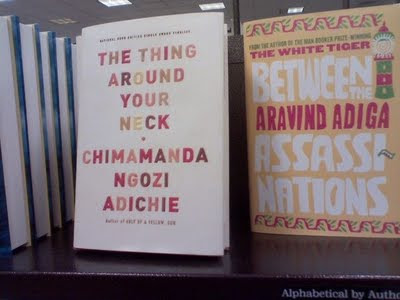
Adichie's The Thing Around Your Neck.

I probably just found my best Barnes and Noble, the one in the Birdcage shopping center in Sacramento. Not only was I able to find the African literature titles I have been looking for, but they were merchandised face-out, to show that they are hot items. Even when I couldn't find one of the titles, a bookseller walked me to the shelf, and there, face-out, was Adoabi T. Nwaubani's novel, I Do Not Come to You by Chance.

Then what the bookseller said after that was just wonderful: "African fiction is the new hot product in the market, even the music department is seeing many new African titles, especially from Southern Africa."

I stood there smiling. I am happy that finally I can walk into a bookstore and find some of the latest African titles on the shelves. Ten years ago that was not the situation. I even worked for a bookstore myself as an inventory manager, and I remember how dismal my efforts to acquire African titles were. Not now; this is indeed Africa's time... and that counts for a lot because the talent coming out of the continent is breathtaking. This is not just a sense of nostalgia, but we are talking of big corporations reaching for a piece of the African cake....

So, of course, I took a few photos, following Paulo Coelo's example of posting bookstore displays of his books on his blog. These books were displayed under New Fiction:

Irene Sabatini's The Boy Next Door.

Petina Gappah's An Elegy for Easterly.

I knew I was going to do some impulsive purchases. Since I already own the books pictured here, I ended up buying Uwem Akpan's paperback edition of Say You Are One of Them, a winner of the Commonwealth Prize, Adoabi Tricia Nwaubani's I Do Not Come to You by Chance (I made the mistake of reading the prologue. I liked the , detail, voice, and humor), and my third copy of Things Fall Apart, which means that now I will have three copies on my shelf, but they are different editions signifying different printings. The one I got today satisfies the scholar in me--it is the Norton Critical Edition, which contains background information, critical essays and other documents that help a student of the book understand the criticism, content, and context of the novel. It's a good 590 pages.

THE SEÁN Ó FAOLÁIN SHORT STORY CONTEST SHORTLIST AND COMMENDATION

2009 Shortlist and Commendation

(alphabetical order)

"Snow" by Elaine Barnard, California, USA

"Cold Cut" by Alexa Beattie, CT, USA

"Harm" by Michael Copperman, Oregon, USA

"Southern Hospitality" Alyn Fenn, Co.Cork, Ireland

"My Friend Joe" by David Mohan, Co. Dublin, Ireland

"The Mason's Tale" by Alec Solomita, MA, USA

"Holding On" Sheena Wilkinson, Co. Down, N. Ireland


Commendations

(In order of entry)


“The Shaman Can’t Call the Spirit Home” Benjamin Arda Doty, Mn, USA

“Scattered Teeth” Tabitha Roemish, Seattle, USA

“The Statistician” Richard Scarsbrook,Toronto, Canada

“The Fallen Cone” Sasha Margolis, Ohio, USA

“Nel Mezzo del Camin” James Moynihan, Cork, Ireland

“The Sky at Night” Robert Keaton Mac Donald, California, USA

“Giving Up” Gerry McCullough, Northern Ireland

“The Girl in the Window” Brian Kirk, Dublin, Ireland

“Island Shaman” René J. Navarro, Pennsylvania, USA

“The Girl at the Fair” Howard Petote, North Carolina, USA

“ Italian Lesson” Grace French, Dublin, Ireland

“The Grind” Dónal Moloney, Waterford, Ireland

“Waiting for the Bullet” Madeleine D’Arcy, Cork, Ireland

“The Boys” Emily Firetog, Dublin, Ireland

“Dancers” Andrew Fox, Dublin, Ireland

“Losing Amanda” Andrew Rogers, North Carolina, USA

“Never, Ever bring this Up Again” Luke Woods, New York, USA

“A Smudge of Color” Chris Nicholson, New York, USA

“The Cost of Fuel” Kathryn Hively, New Jersey, USA

"Dilation" Beverly Parayno, California, USA

Comment: It is obvious from the above lists that the United States dominated in the contest, and that all the names are from North America and Ireland. Where is everybody?

Thursday, September 3, 2009

Ah, poetry...

Since the beginning of summer (let's be honest, since February) my reading has been focused on literary fiction, particularly the short story. The poetry books have been piling up, waiting to be read.

I can't wait to get started on John Amen and Alice Teeter's new collections. I love reviewing poetry, so watch this space. I'm, as they say, kinda busy and should take it easy on reading for pleasure, but I can fit in one or two volumes of poetry here and there.

Wednesday, September 2, 2009

A Couple of Reviews in Farafina 17: Adichie and Chikwava


Farafina 17 features my reviews of Brian Chikwava's Harare North and Chimamanda Adichie's The Thing Around You Neck. Go there and read the reviews.

Blog Archive

About Me

My Photo
Emmanuel Sigauke
I am currently reading Kazuo Ishiguro, Ernest Hemingway, Nadine Gordmer, D.H. Lawrence,Dambudzo Marechera, and Leo Tolstoy, Yusef Komunyakaa, Christopher Vogler, Thomas Hardy
View my complete profile